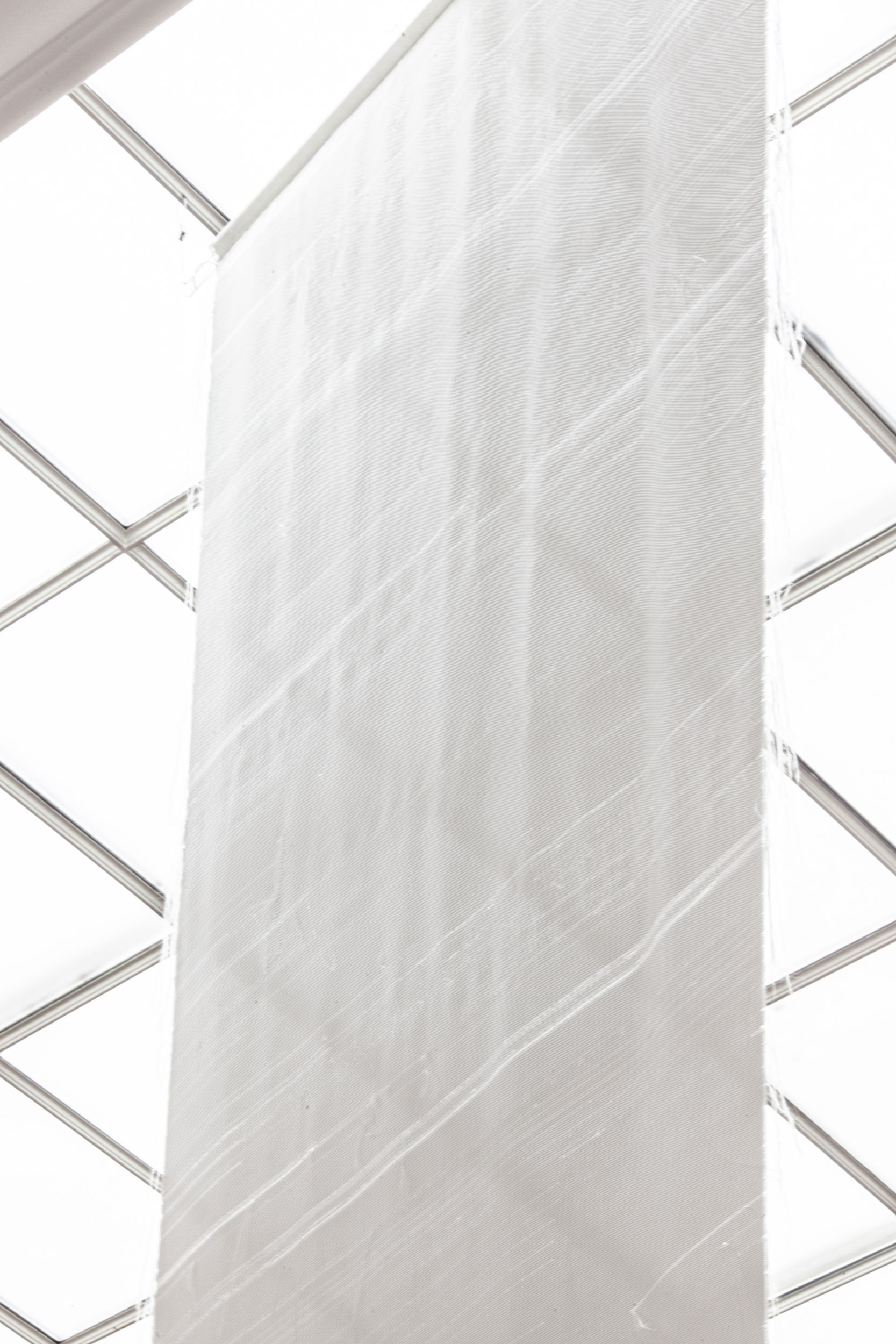
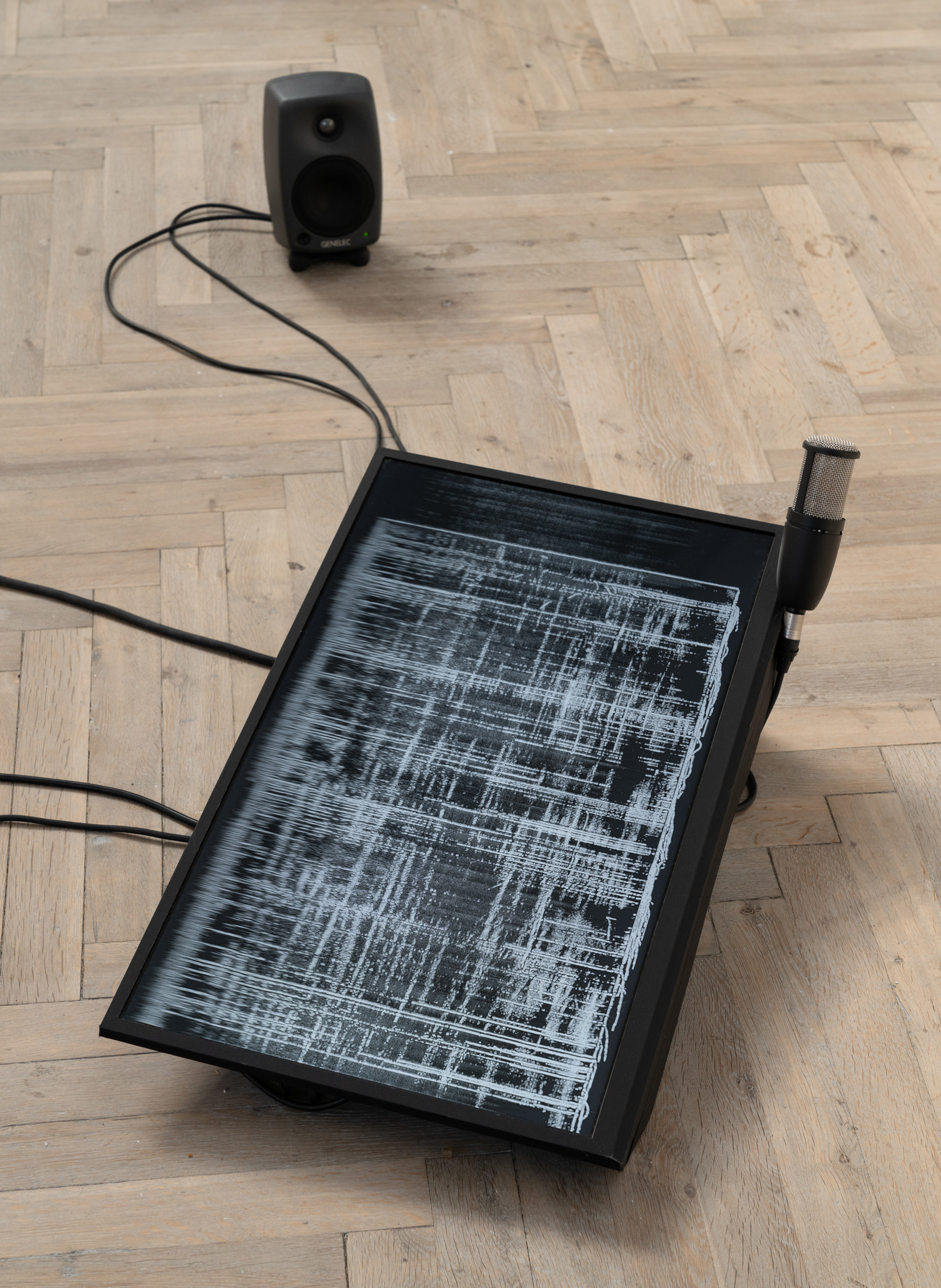
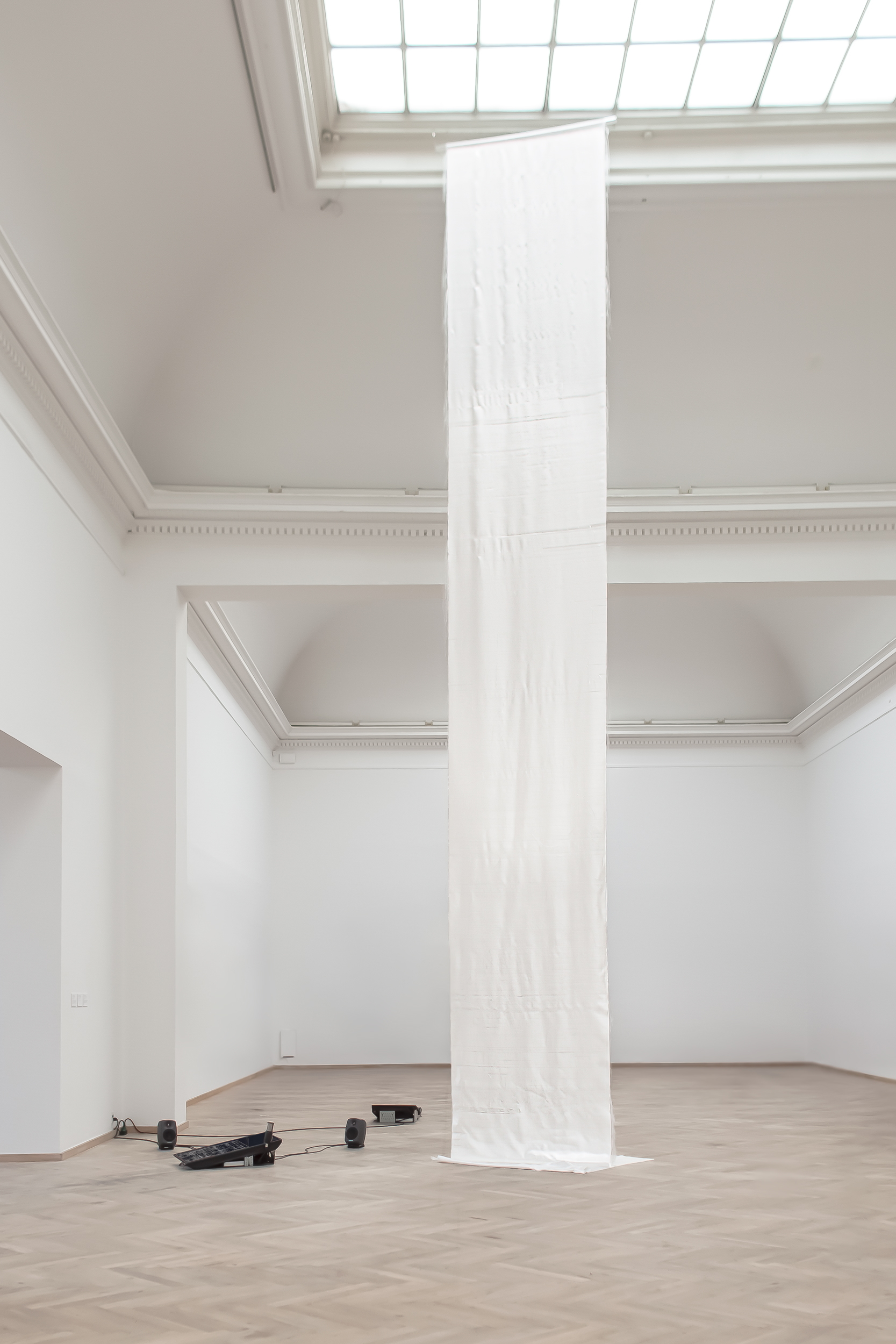
Strategic Opacity, Opus 20,2020 fiberglass woven fabric ( 120 cm x 900 cm ) analog composition with orchestrations by Simon Björk and Simon Brinck, speakers, microphone, spectrogram digital video (6:53 min and 8:13 min.)
TXT [DK] : : Ved udelukkende at være vævet af glasfibre nærmer Toke Højby Lorentzens værk Strategic Opacity, Opus 20 sig dagens kommunikationsteknologis infrastruktur, hvor data ledes gennem glastråde. Samtidig henviser værkets industrielt fremstillede glasfibervæv teknologihistorisk set til den automatiserede væv og anvendelsen af hulkortet til datalagring og –overførsel. Her udnyttes, at fraværet af en ting kan være lige så informationsgivende som dens tilstedeværelse. Lorentzen har udsat det industri-vævede materiale for videre bearbejdning ved at trække tråde ud af det igen, enkeltvist og metodisk. Den betydning der indtræffer efter håndens intervention, og de heraf opståede afvigelser fra det industrielle vævs rigide system, kan blandt andet tilgås som data ligesom hulkortet kan.
Strategic Opacity tager sin titel fra litteraturhistoriker Stephen Greenblatt, der anvender begrebet til at beskrive, hvordan udeladelse eller fravær af forklarende nøgleelementer i et narrativ, kan skabe en mere intens oplevelse for den meningsskabende læser og derved ende med at give fortællingen en dybere betydning. For yderligere at bearbejde vævets data har Lorentzen scannet vævet, hvorefter han har engageret to komponister til at aflæse vævets mønster som et partitur og hver især opsætte et system for aflæsningen.
TXT [EN] : : Being woven exclusively out of glass fibres, Toke Højby Lorentzen’s Strategic Opacity, Opus 20 approximates the infrastructure of present-day communication technology where data is transmitted via fiberoptic cables. At the same time, the industrially manufactured fiberglass woven fabric points back to the history of technology, referencing the automated loom and the use of punched cards to store and transfer data. Such technology made use of the fact that the absence of a given thing can provide as much information as its presence. Lorentzen has subjected the industrially woven material to further processing by manually pulling threads out of it, individually and methodically. The new significance created by this intervention made by human hand, and the deviations it causes from the rigid system of the industrial fabric, can be accessed as data, in the same way as that of a punched card.
Strategic Opacity takes its title from the literary historian Stephen Greenblatt, who uses the term to describe how the omission or absence of key explanatory elements in a narrative can create a more intense experience for the reader, thereby ultimately giving the narrative deeper meaning. To further process the data found in the fiberglass fabric, Lorentzen scanned it and had two composers read the patterns found there as a musical score, each setting up an individual system for their reading.
Curating and text by Helga Just Christoffersen
Strategic Opacity, Opus 20, 2020
fiberglass woven fabric (120 cm x 900 cm) speakers, microphone, monitors w/ spectrogram and digital video (6:53 min and 8:13 min.)
Strategic Opacity, Opus 20, Side A2020 excerpt from digital video, orchestration by Simon Björk ( 8:13 min. full length)
Hos Toke Højby Lorentzen anvender vi cookies for at følge med i hvordan de besøgende bruger siden. Oplysningerne deles også med vores samarbejdspartnere. Ved at trykke OK giver du samtykke til at Toke Højby Lorentzen og tredjeparter anvender cookies på denne side
This website uses cookies to improve your experience while you navigate through the website. Out of these, the cookies that are categorized as necessary are stored on your browser as they are essential for the working of basic functionalities of the website. We also use third-party cookies that help us analyze and understand how you use this website. These cookies will be stored in your browser only with your consent. You also have the option to opt-out of these cookies. But opting out of some of these cookies may affect your browsing experience.
Necessary cookies are absolutely essential for the website to function properly. These cookies ensure basic functionalities and security features of the website, anonymously.
Cookie
Varighed
Beskrivelse
cookielawinfo-checbox-analytics
11 months
This cookie is set by GDPR Cookie Consent plugin. The cookie is used to store the user consent for the cookies in the category "Analytics".
cookielawinfo-checbox-functional
11 months
The cookie is set by GDPR cookie consent to record the user consent for the cookies in the category "Functional".
cookielawinfo-checbox-others
11 months
This cookie is set by GDPR Cookie Consent plugin. The cookie is used to store the user consent for the cookies in the category "Other.
cookielawinfo-checkbox-necessary
11 months
This cookie is set by GDPR Cookie Consent plugin. The cookies is used to store the user consent for the cookies in the category "Necessary".
cookielawinfo-checkbox-performance
11 months
This cookie is set by GDPR Cookie Consent plugin. The cookie is used to store the user consent for the cookies in the category "Performance".
viewed_cookie_policy
11 months
The cookie is set by the GDPR Cookie Consent plugin and is used to store whether or not user has consented to the use of cookies. It does not store any personal data.
Functional cookies help to perform certain functionalities like sharing the content of the website on social media platforms, collect feedbacks, and other third-party features.
Performance cookies are used to understand and analyze the key performance indexes of the website which helps in delivering a better user experience for the visitors.
Analytical cookies are used to understand how visitors interact with the website. These cookies help provide information on metrics the number of visitors, bounce rate, traffic source, etc.
Advertisement cookies are used to provide visitors with relevant ads and marketing campaigns. These cookies track visitors across websites and collect information to provide customized ads.