Strategic Opacity, Opus 23
exhibition view Nikolaj Kunsthal, 2023
Strategic Opacity, Opus 23, 2023
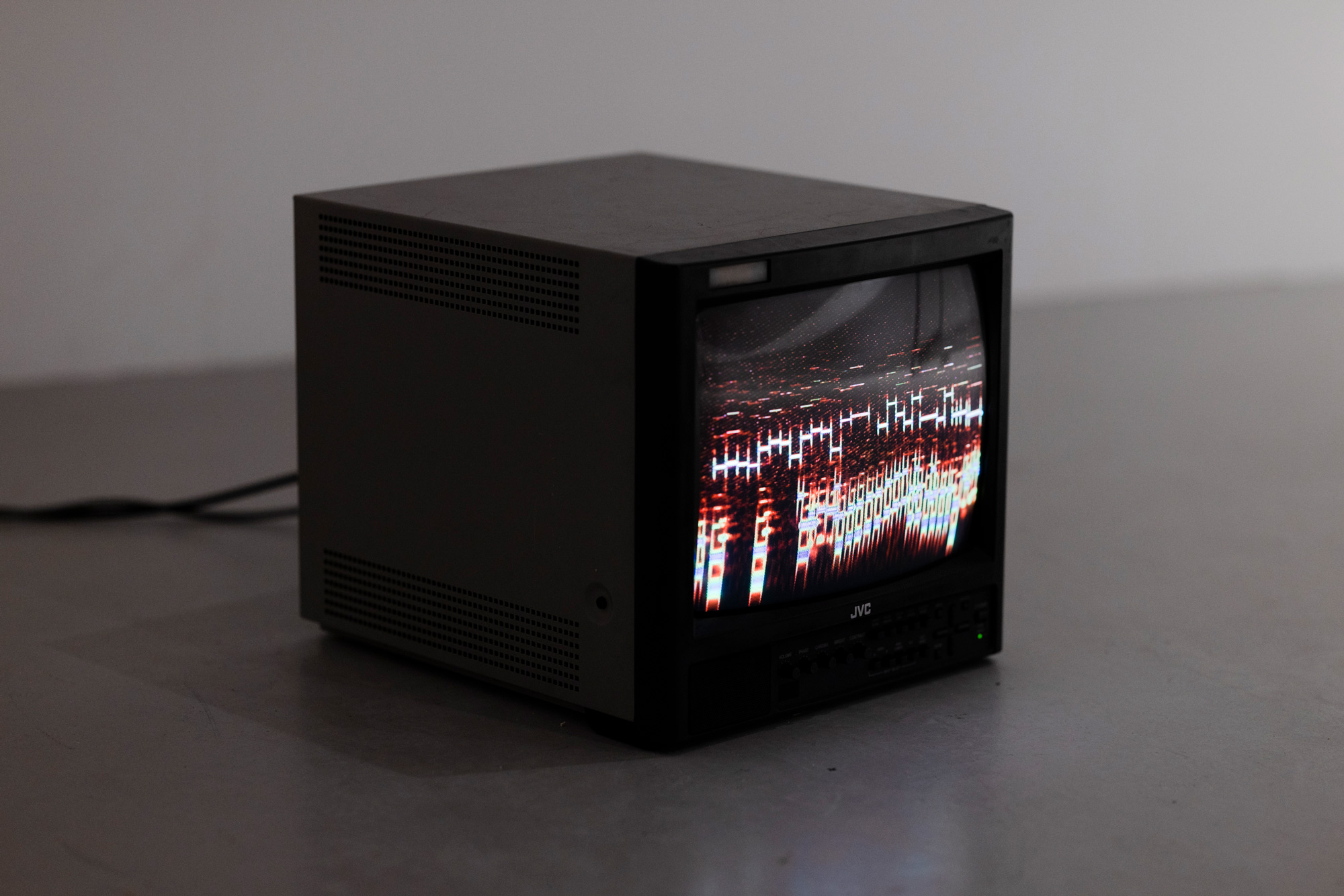
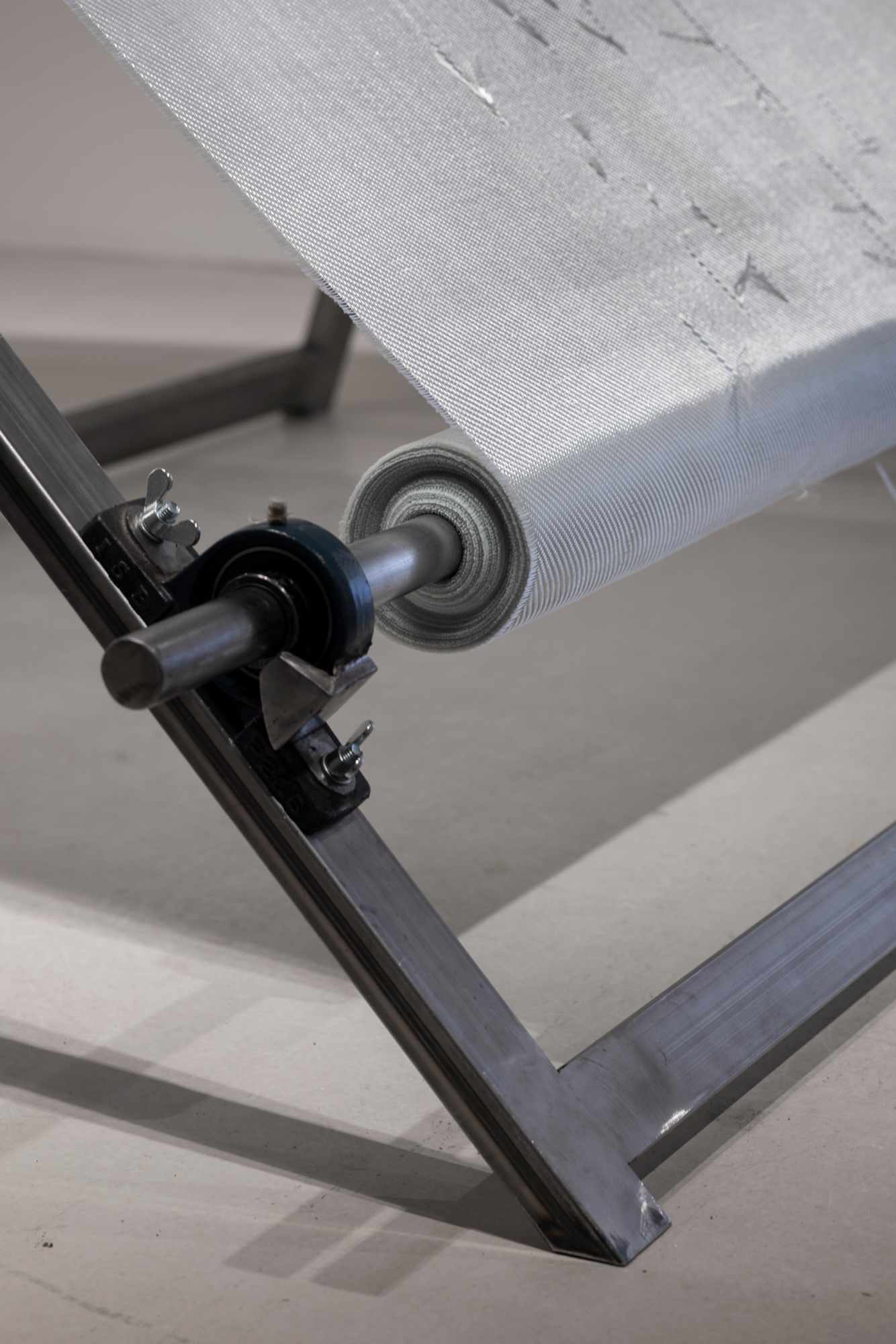
Fiberglass woven fabric (120 x 4.000 cm), steel trestles, analog rework of the organ works Diptyque (1930) and Apparition de l’Eglise éternelle (1932) by Olivier Messiaen (1908 – 1992), speakers, spectrogram, QR code, digital video (15:00 min.)

Toke Højby Lorentzen undersøger i sit kunstneriske arbejde, hvordan nye betydninger og forbindelser opstår, når tegn, sprog og materiale rekontekstualiseres. I dette arbejde sammenstilles samtidige kommunikationsformer som kodesprog og QR-koder med historiske kommunikationssystemer som hulkort og nodeskrivning. I udstillingen Strategic Opacity, Opus 23 danner disse sammenstillinger et ekkokammer af oversættelser og sammenfiltrede betydninger.
I udstillingsrummet er et i alt 40 meter langt industrielt fremstillet glasfibervæv udspændt mellem to metalstativer. Vævet er et informationsbillede, hvor udvalgte tråde systematisk og manuelt er trevlet op, hvilket danner et hulmønster, som kan aflæses og spilles som musikstykke.Vævets længde indikerer kompositionens varighed, mens dets bredde angiver tonernes frekvenser. Kompositionen er inspireret af de to orgelværker Diptyque og Apparition de l’Eglise éternelle af den franske komponist Olivier Messiaen fra henholdsvis 1930 og 1932, samme periode som orglet i Nikolaj Kunsthals kirkeskib er bygget.
Strategic Opacity, Opus 23 er et loop af oversættelse og flow af information; et væv af sammenflettede betydninger, hvor vekselvirkningen mellem håndens arbejde og industriel teknologi er i konstant forhandling. Vævets informationsbillede bliver i udstillingen afsæt for videre oversættelse. Som spektrogram, som partitur til orgel, og som musikstykke, indspillet på orglet i Nikolaj Kunsthal, der afspilles hvert kvarter.
Med udviklingen af den industrielle væv op igennem 1700-tallet blev hulkortet anvendt til lagring af vævets mønster. Hulkortet angav, hvorvidt tråden skulle gå over eller under, hul eller ingen hul. Dette princip er kendetegnende for binær kode, som også har formet opfindelser som spilledåsen, automatiserede klokkespil, det selvspillende klaver (pianolaen), og ikke mindst været definerende for moderne computerteknologi. Glasfibervævet i udstillingen indskriver sig således i denne fortælling; som væv og som datasæt, mens materialet, der ellers bruges som byggemateriale, får fornyet formål og stemme.
Udstillingen tager sin titel fra litteraturhistoriker Stephen Greenblatt, der bruger begrebet ”strategic opacity” til at beskrive den pirrende effekt,
der opstår, når information bevidst tilbageholdes.
I en samtid med uigennemskueligt store mængder information, bearbejder Lorentzen i Strategic Opacity, Opus 23 vores forhold til de faktiske, påståede og poetiske sammenhænge og betydninger, der opstår i spændingsfeltet mellem det bestående og det fjernede, det vi fornemmer og det vi ved, det tilbageholdte og det synlige.
Udstillingstekst og kuratering
af Marie Vinther
English translation [EN] : : :
The emergence of new meanings and connections through the recontextualisation of sign, language, and material is integral to Toke Højby Lorentzen explorative practice. This unfolds by placing modern forms of communication in contrast to historical communication systems. The exhibition, Strategic Opacity, Opus 23, showcases these juxtapositions, forming an echo chamber of translations and tangled meanings.
The show features a 40 meter long industrially produced fiberglass woven fabric suspended between two steel trestles. The fabric serves as an information image, with selected threads manually and systematically unraveled to form a perforated pattern that can be read and played as a piece of music. The fabric’s length represents the duration of the sound piece, while its width indicates the frequencies of the notes. The composition draws inspiration from two organ works by the French composer Olivier Messiaen (1908 – 1992), Diptyque and Apparition de l’Eglise éternelle, composed in 1930 and 1932, respectively, around the same time as the organ in the church nave of Nikolaj Kunsthal was built.
Strategic Opacity, Opus 23 embodies a loop of translation and information flow, creating a web of intertwined meaning, where the interaction between the work of the hand and industrial technology is in constant negotiation. The exhibition utilizes the fabric’s information image as a starting point for further translation, serving as a spectrogram, as a score for organ, and as a recording of the organ at Nikolaj Kunsthal, played in a fifteen minutes loop.
Punched cards were used to store the weave pattern with the development of the industrial loom up through the 18th century. This principle, indicating whether the thread should go over or under, hole or no hole, is characteristic of binary code. It has shaped inventions such as the music box, automated carillons, and the player-piano, and has been instrumental in defining modern computer technology.
The fiberglass woven fabric in the exhibition thus inscribes itself into this narrative as fabric and as data set and the material usually used as building material is given a renewed purpose and voice.
The exhibition takes its title from literary historian Stephen Greenblatt, who uses the term “strategic opacity” to describe the tantalising effect that occurs when information is deliberately withheld. In a time that is inundated with vast amounts of information Strategic Opacity, Opus 23 contemplates our relationship with the genuine, supposed, and poetic connections and meanings that arise amidst the tension between what exists and what has been removed, what we sense versus what we know, the detained versus the visible.
Exhibition text and curation by
Marie Vinther
English translation Nikolaj Kunsthal



Supported by: Statens Kunstfond, Rådet for Visuel Kunst, Grosserer L. F. Foghts Fond, Det Obelske Familiefond og Dansk Tennis Fond